
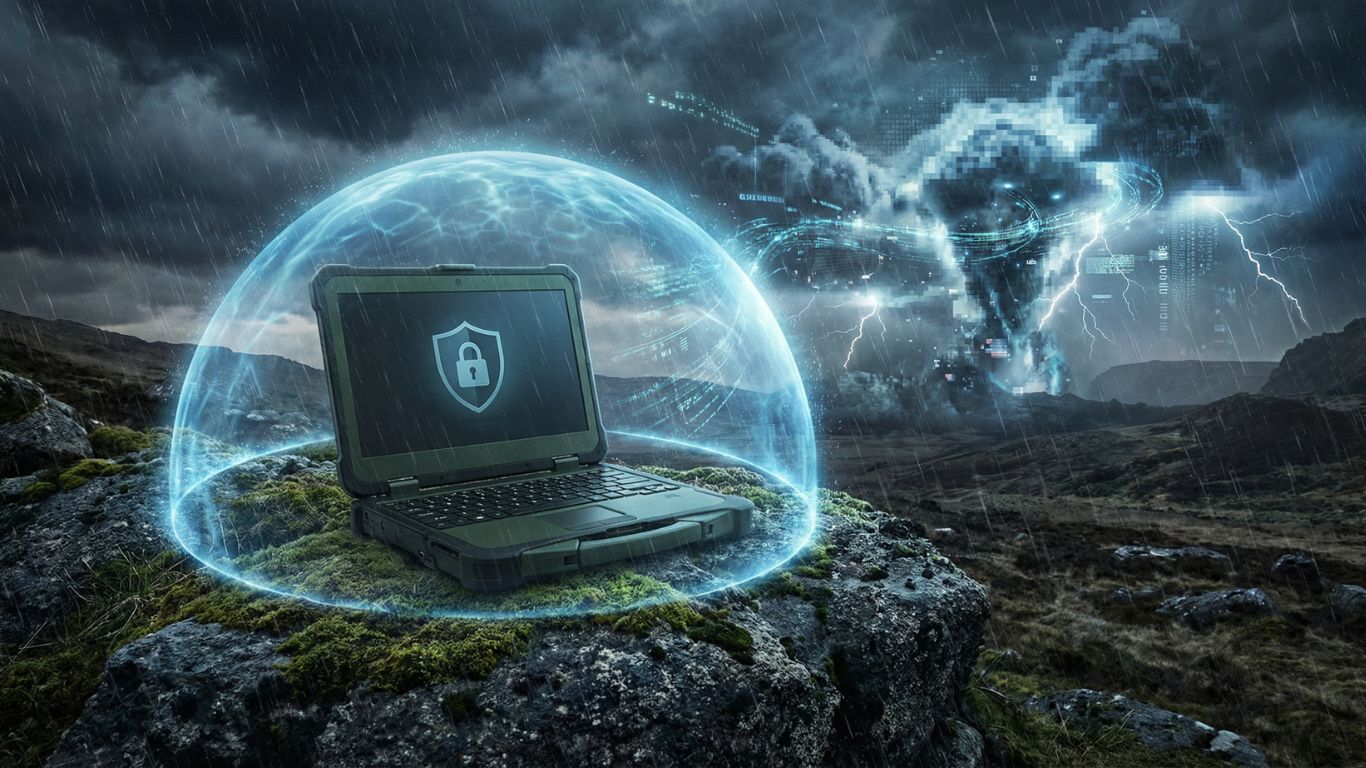
In mission-critical environments—whether traffic control centers, financial trading back offices, or manufacturing and energy operations—"downtime" isn't just an inconvenience; it directly impacts safety, compliance, and revenue. In the AI era, as systems grow smarter and dependencies deepen, resilience becomes non-negotiable. Ze Yu United Development has long served these environments, and we believe: mission-critical moments cannot tolerate disconnection—they demand "military-grade" resilience thinking in design and operations.
"Military-grade" isn't marketing language—it's a verifiable standard: shock resistance, dust and water protection, wide temperature range, continuous long-term operation, and full-chain hardware-to-software redundancy and recovery capabilities. Through projects with MEP communications, Bumicom recording systems, and Panasonic ruggedized laptops, Ze Yu has repeatedly validated one principle: in harsh environments and under high loads, systems must "prioritize stability over speed." At critical nodes, single points of failure must be eliminated—or at minimum, isolated and rapidly recovered.
Resilience isn't just buying the most expensive equipment—it's assuming at every stage—architecture design, deployment, monitoring, operations—that things "will break, will disconnect, will overload," and still maintaining critical services when they do.
After AI adoption, resilience thinking must extend to "models and data": Does the model service have multi-node redundancy, load balancing, and automatic failover? Are training and inference data pipelines isolated from critical business operations to prevent single failures from cascading? When integrating Doni AI with enterprise systems, Ze Yu insists on designing AI modules with "graceful degradation"—when GPUs or model services fail, core business processes can still fall back to preset rules or manual intervention, preventing total system shutdown from AI failures.
From Hardware to Software: Two Sides of Resilience
On the hardware side, we continue supporting Panasonic military-grade laptops and ruggedized tablets, enabling field personnel to operate reliably under vibration, dust, humidity, and extreme temperatures. MEP communications and Bumicom recording systems ensure critical voice and data are never lost or interrupted under control and audit requirements. On the software side, redundant deployment, health checks, automatic retries, and escalating alerts enable "downtime" to be predicted before it happens and quickly located and recovered when it does.
- Hardware Resilience: Military-grade equipment, wide temperature range, dust/water protection, continuous long-term operation
- Architecture Resilience: No single points of failure on critical paths, redundancy and automatic failover
- AI Resilience: Model services with graceful degradation, isolated from core business, manual override during anomalies
- Operational Resilience: Monitoring, alerts, drills, and recovery workflows as standard practice
- Compliance & Audit: Recording, logs, and audit trails traceable and recoverable
Mission-critical resilience—this is Ze Yu's standard for ourselves and our promise to every client. In today's accelerating AI and digital transformation landscape, only military-grade resilience thinking can ensure intelligence becomes an asset, not a new risk. The Ze Yu team stands ready to work with you, building every mission-critical line into a rock-solid foundation that withstands any test.